Self-improvement: how Chad gets better on his own
Chad doesn't just run workflows — he runs workflows that improve the workflows.
Three loops, all Approval-gated and all visible in the Runs IDE,
turn each night's runs into the next night's edge: an evolutionary arena that
breeds better prompts, a cost loop that proves when a cheaper model is good
enough, and a maintenance loop where Chad files his own bugs and enhancement
ideas. A fourth primitive — workflow chaining — lets these compose into
pipelines.
Everything here is grounded in real run data, not vibes: the loops read the durable Smithers SQLite DBs (every frame of every past run) and the operator's steering directives before proposing a change.
The evolutionary arena (experiments.jsx)
The arena is a genetic loop over drafter prompts: start wide with a population of prompt variants, score each against a fixture set, keep the winners, breed mutants, retire the losers. It runs nightly and reports a leaderboard in the Experiments tab.
flowchart LR
    Dir[Directives<br/>operator steer] --> Mut
    Sig[DB signal<br/>why runs failed] --> Mut[mutatePrompt<br/>reflective breeding]
    Fix[Fixtures<br/>real run inputs] --> Score
    Pop[(Population<br/>champions)] --> Score[Score variants]
    Mut --> Pop
    Score -->|keep winners| Pop
Score --> Board[Leaderboard<br/>+ cost savings]- Trace-grounded mutation. Breeding isn't random.
lib/signal.jsscans every workflow DB for failed / stale / low-quality runs and extracts why they failed from the agent trace;mutatePrompt()reads that signal plus the operator directives, so a new variant targets a concrete failure mode (the same principle as Genetic-Pareto prompt evolution — mutations explain themselves). - Real fixtures.
lib/fixtures.jsharvests evaluation inputs from actual past run inputs across the DBs (harvestFixtures), merged with a curated static set instate/fixtures.json. The arena scores against work Chad has really been asked to do, not synthetic toy prompts. - Champions persist. Winning variants are stored and reused as the seed
population — and as the auto-selected panel for
fusion.jsx.
Directives: steering the loop
state/directives.json is the operator's steering wheel — the global default,
resolved through lib/directives.js and honored by the arena and every agent.
All four fields are live:
experiments(free text) steers the arena's breeding + scoring ("favor terse, cite-grounded drafts").creativity(low|moderate|high) tunes how boldly the reflective-mutation step explores —highasks for a genuinely different angle,lowfor a small safe refinement.priorities(task-kinds) scope which fixtures the judge scores against, so the arena focuses on the roles you care about.systemPrompts.{all,<role>}inject into every agent call (directiveSystem(role)), so a steer lands across all workflows, not just the arena.
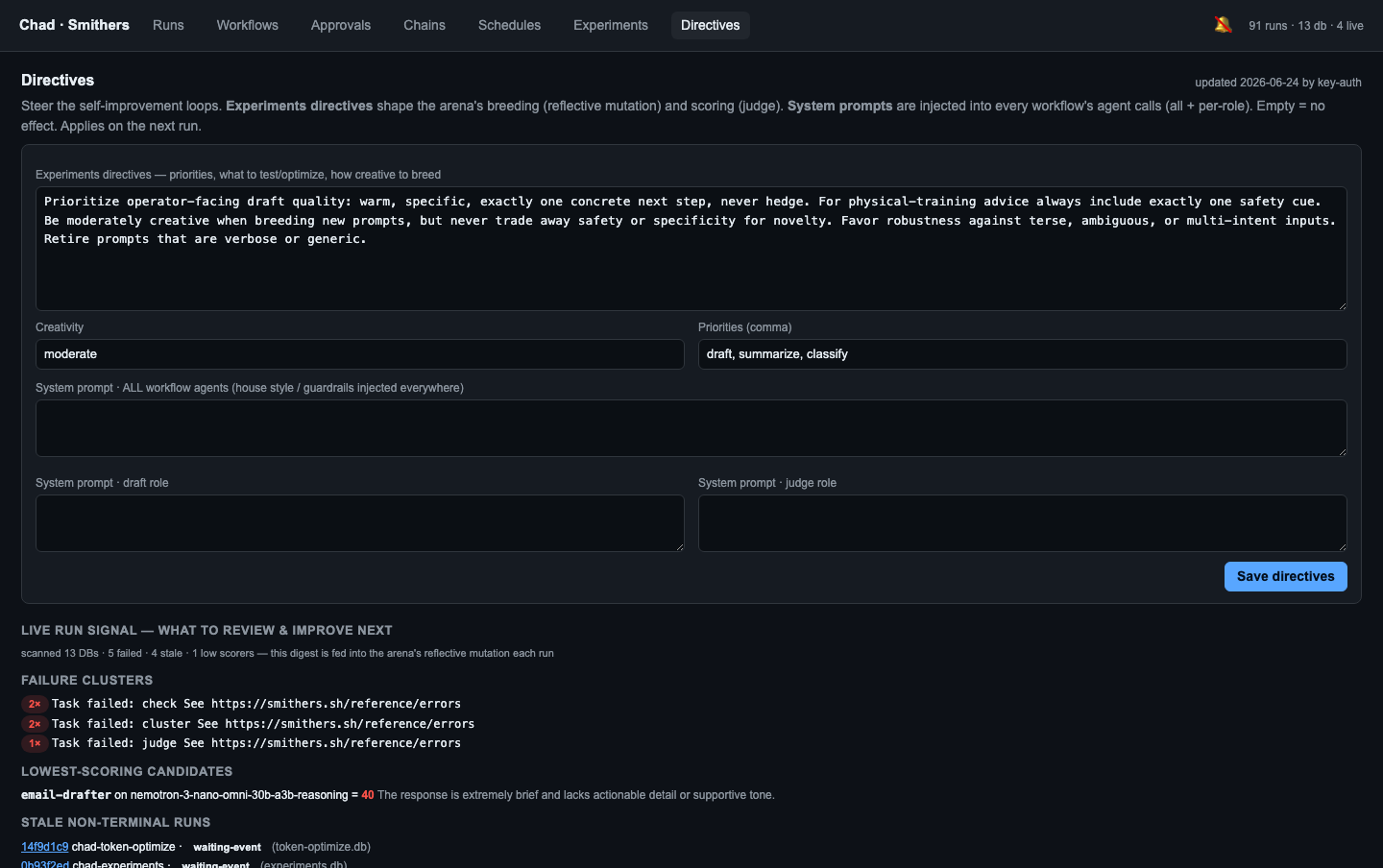
Edit the global set in the Directives tab, or programmatically:
chad-runs directives > /tmp/d.json     # read current global
#   …edit experiments / creativity / priorities / systemPrompts…
chad-runs set-directives /tmp/d.json   # global — lands in the next run + all agent prompts
chad-runs signal --days 7              # see what's feeding the next generation
Experiment on the directives themselves (per-run override)
Directives are also an experiment variable. A run can disable the global set and/or carry its own override, so you can A/B a directive without touching the global default — the launch drawer (Workflows → Launch → Directives) has an "Apply global directives" toggle + an override editor, and headless:
# breed the arena under a bolder directive for ONE run:
chad-runs launch experiments.jsx --directives '{"creativity":"high","experiments":"try a radically terser voice"}'
# test a directive in isolation (ignore the global set for this run):
chad-runs launch experiments.jsx --no-global --directives '{"experiments":"…"}'
Resolution: CHAD_DIRECTIVES_OFF=1 ignores the global file; CHAD_DIRECTIVES_JSON
is the per-run override (merges over global; used alone when global is off). Both
ride the same allowlisted launch env as every other run knob.
The Directives tab also renders the live DB-signal digest and the arena fixtures, so an operator can see exactly what the loop is reacting to.
The cost loop: tokenmaxxing (token-optimize.jsx)
Every capable-tier call costs tokens; many tasks don't need the capable tier.
token-optimize.jsx probes — for each task kind — whether a cheaper model
matches the quality bar, and if so proposes an Approval-gated downgrade that
(on approval + CHAD_TOKENOPT_APPLY=1) is written into task-profiles.json
(snapshot-first, by dot-path). It runs nightly in shadow and feeds two dashboard
views:
chad-runs model-matrix— the best model per task kind (the performance grid).chad-runs efficiency— tokens by workflow + the downgrade savings, realized and proposed. The Experiments tab surfaces the cumulative savings as a hero metric.
The maintenance loop: Chad fixes Chad
Two nightly workflows close the loop on Chad's own reliability — both shadow by
default, both Approval-gated, neither ever edits source directly:
bug-report.jsx— scans failed runs/nodes across the DBs and host service logs, clusters them into distinct bugs, and (on approval +CHAD_BUGREPORT_POST=1) files deduplicated GitHub issues.skill-improve.jsx— proposes enhancements to Chad's own workflows and skills (robustness / perf / cost / feature / docs) and files them as GitHub enhancement issues.
Workflow chaining
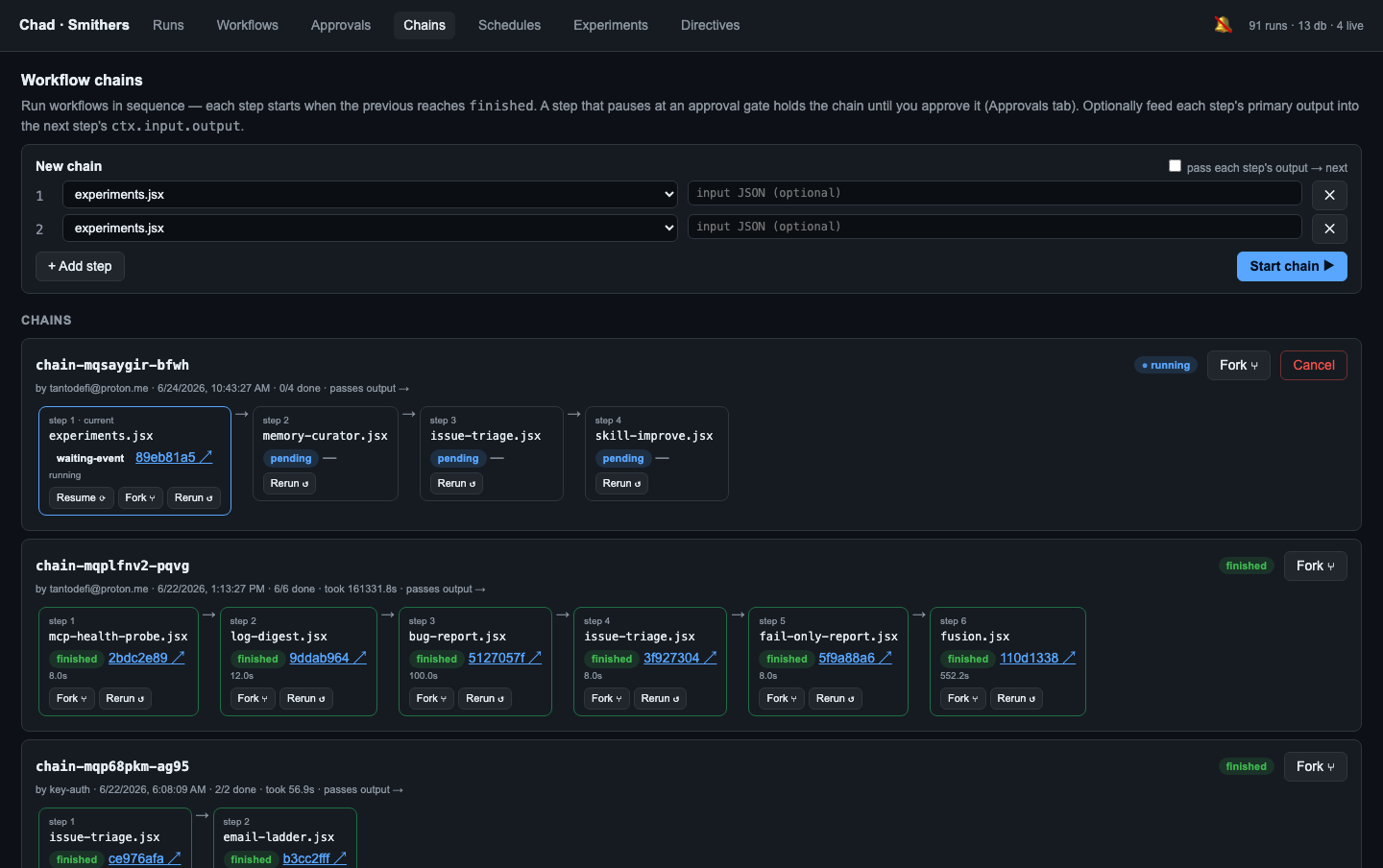
Chaining strings several workflows into a sequential pipeline: each step launches
only after the prior reaches a terminal finished state, optionally feeding the
prior step's primary output forward as the next step's input (passOutput). A step
that pauses at an <Approval> gate holds the chain until the operator approves
— so chains compose cleanly with the autonomy ladder. Chains persist to
state/chains/<id>.json, so an in-flight chain survives a server restart and renders
in the Chains tab.
cat > /tmp/chain.json <<'JSON'
{ "passOutput": true, "steps": [
  { "workflow": "issue-triage.jsx" },
  { "workflow": "content-pipeline.jsx" } ] }
JSON
chad-runs chain-create /tmp/chain.json
chad-runs chains | jq '.chains[0] | {id, status, current}'
# a failed step: chad-runs chain-resume <id>  (or chain-rerun <id> --index 0)
Safety: it's all gated
None of these loops act irreversibly on their own. Every side-effecting step is
shadow-safe by default (it logs what it would do) and takes an explicit env
flag to go live, then still passes through an <Approval> gate the operator
resolves in the dashboard or with chad-runs approve. The design bias is
deliberate: Chad proposes, the operator disposes — and because proposals are
issues and gated diffs rather than silent edits, every change is reviewable. See
Autonomy & action gate for the trust model.
How this compares — Smithers burns, Nous Hermes
Chad's loops were built against two reference points, and the comparison sets the near-term roadmap:
- Smithers
burns(the upstream "Smithers Manager") is the closest analogue to the runs IDE: a Bun daemon + React UI + SQLite that supervises runs, edits workflows, and handles approval gates. Chad's dashboard matches it for single-workspace supervision and adds the self-improvement tabs (Directives, Experiments, Chains). Whatburnshas that's on our list: multi-repo/workspace aggregation, real-time event streaming (the Smithers 0.24 gateway would give us this natively — see Runs IDE), and AI-assisted workflow authoring in the editor. - Nous Hermes self-evolution uses DSPy + GEPA (Genetic-Pareto Prompt
Evolution) with trace-grounded mutations — read execution traces to learn
why a run failed, then propose a targeted fix. Chad's arena is built on the same
principle (
lib/signal.js+ directive-steered breeding + harvested fixtures), and selection is now Pareto (quality↑ vs cost↓): a leaner, slightly-weaker variant survives alongside the top scorer instead of being retired, so the arena keeps the whole trade-off frontier.
What's next (deliberately gated). Hermes closes its loop by opening PRs
behind constraint gates (test suite, size limits, semantic preservation, human
review); Chad stops at filing issues because he has no direct git-write to the
source repo by design (Autonomy). The bridge is a constraint-gate
report — attach "tests pass / size ok / lint clean" evidence to each skill-improve
proposal — so a human PR is one review away without Chad ever auto-writing source.
The building blocks now exist: code-review-loop.jsx
(a produce→judge→refine <Loop> that converges on approved) is the review half, and Smithers'
own fix-all-issues workflow (0.24.2) is the upstream reference for the full
issue→implement→PR pipeline when it's time to wire it. Chain them:
issue-triage → code-review-loop already runs today as a chain.